
While Marilyn Monroe famously sang, “Diamonds are a girl’s best friend,” she could have just as easily been talking about the advantages of diamond honing tools in ID bore finishing.
In high-volume manufacturing, pennies matter. Choosing the right tooling can make or break a project’s profitability, and one of the most overlooked factors in that equation is tool life.
Tool Price Alone Doesn’t Tell the Whole Story
Consider this example: two companies are each processing 100,000 identical parts.
- Company A pays $500 for a tool.
- Company B pays $1,300 for a tool.
At first glance, Company A appears to have the better deal. But that only holds true if the price of the tool is the only variable that matters.
In manufacturing, that is rarely the case.
If Company A’s tool lasts for only 1,500 parts, while Company B’s tool lasts for 10,000 parts, the numbers change quickly. Company A would need roughly 67 tools to complete the job, while Company B would need only 10. That means Company A would spend about $33,500 on tooling, compared to $13,000 for Company B.
That is a savings of more than $20,000 on tooling alone, before even factoring in labor, machine downtime, tool changes, or scrap.
Why Tool Life Matters So Much
Longer-lasting tools do more than reduce replacement costs. They also support a more stable, predictable process.
“Our customers have shared with us that the longevity of our tools has been such a great advantage for them,” said Kevin Domanski, Accu-Cut’s Executive Vice President. “When tools can last tens of thousands of parts, it drastically reduces their operating and per piece part costs.”
For manufacturers running large volumes, that kind of consistency matters. Fewer tool changes mean less interruption, fewer opportunities for variation, and better throughput over the life of the job.
Why Diamond Outperforms Conventional Tooling
Material hardness and abrasiveness create challenges for many tool manufacturers because carbide wears down and dulls relatively quickly. In demanding bore-finishing applications, that wear can show up fast in the form of declining geometry control and inconsistent surface finish.
Diamond tooling changes that equation.
Because diamond tools are significantly harder than conventional tool materials, it remains sharp for tens of thousands of parts. That allows it to cut ID bores more freely and maintain size, geometry, and finish over a much longer production run.
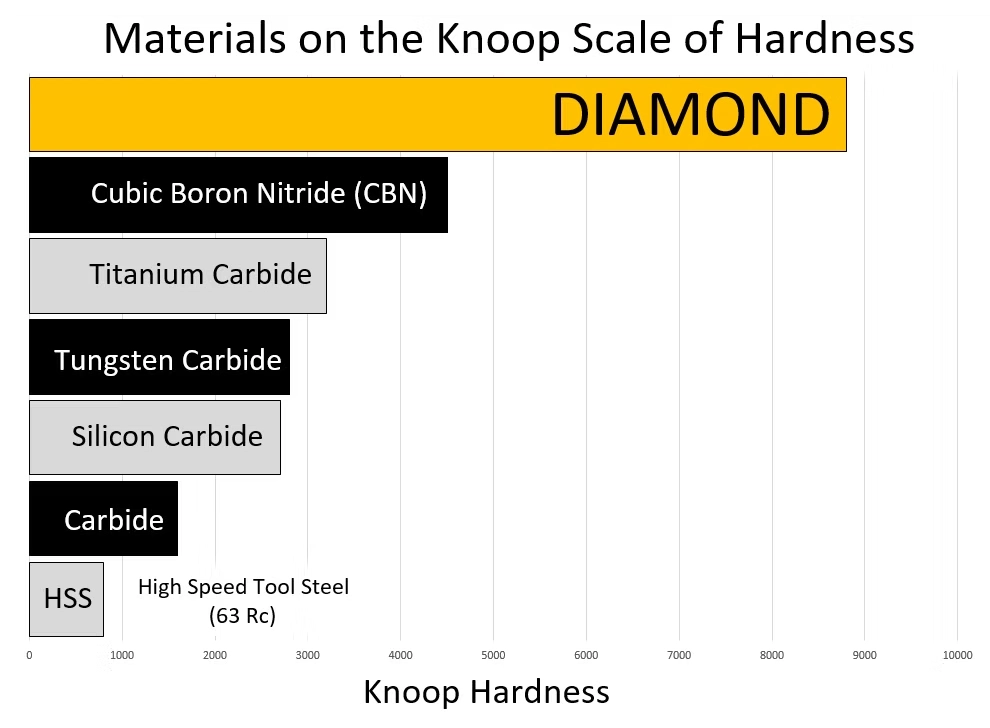
By contrast, a duller tool can quickly bring parts out of spec. That creates a chain reaction of added cost:
- More tool replacements
- Higher scrap rates
- More operator intervention
- Additional machine downtime
In other words, the real cost of a tool is not just what you pay up front. It is what that tool costs your operation over the full run.
Lower Cost Per Part, Better Competitive Advantage
Producing a high-quality part through a stable, cost-effective process gives manufacturers a real competitive advantage. When bore finishing can be done with better consistency and longer tool life, shops are in a stronger position to control costs and deliver reliable results at scale.
Diamond tooling changes the playing field and significantly boosts capabilities when it comes to precisely finishing bore IDs.